The AI Illusion: The Model Isn't Autonomous. The System Is
Why corporate AI fears focus on the wrong thing: the model is a stored mathematical object, and the real security boundary is the context, memory, tools and permissions built around it.
The gap between startups and large corporations in AI adoption is massive. Startups typically embrace the AI revolution at full throttle, sometimes compromising on data security in the race to innovate. Large corporations often sit at the other extreme. They push back against deeper integration, paralyzed by marketing buzzwords, security warnings, and the fear of "autonomous AI." The result is often a tightly controlled, enterprise-friendly solution such as Microsoft Copilot.
But what actually constitutes AI, and what should we really be afraid of?
Traditionally, human-written software operates according to predefined instructions, with the underlying hardware executing those instructions step by step. AI is not exempt from the same computational reality. A trained AI model is ultimately a stored mathematical object: a large set of parameters produced through an optimization process. It is not a self-running program with its own network connection, filesystem, keyboard, or authority to act.
A useful analogy is to think of the model as a highly complex mathematical artifact rather than an independent digital organism. You can store it on a hard drive indefinitely. Nothing happens until some software loads the model, provides input, and performs inference.
This distinction is important because modern AI products are not just models.
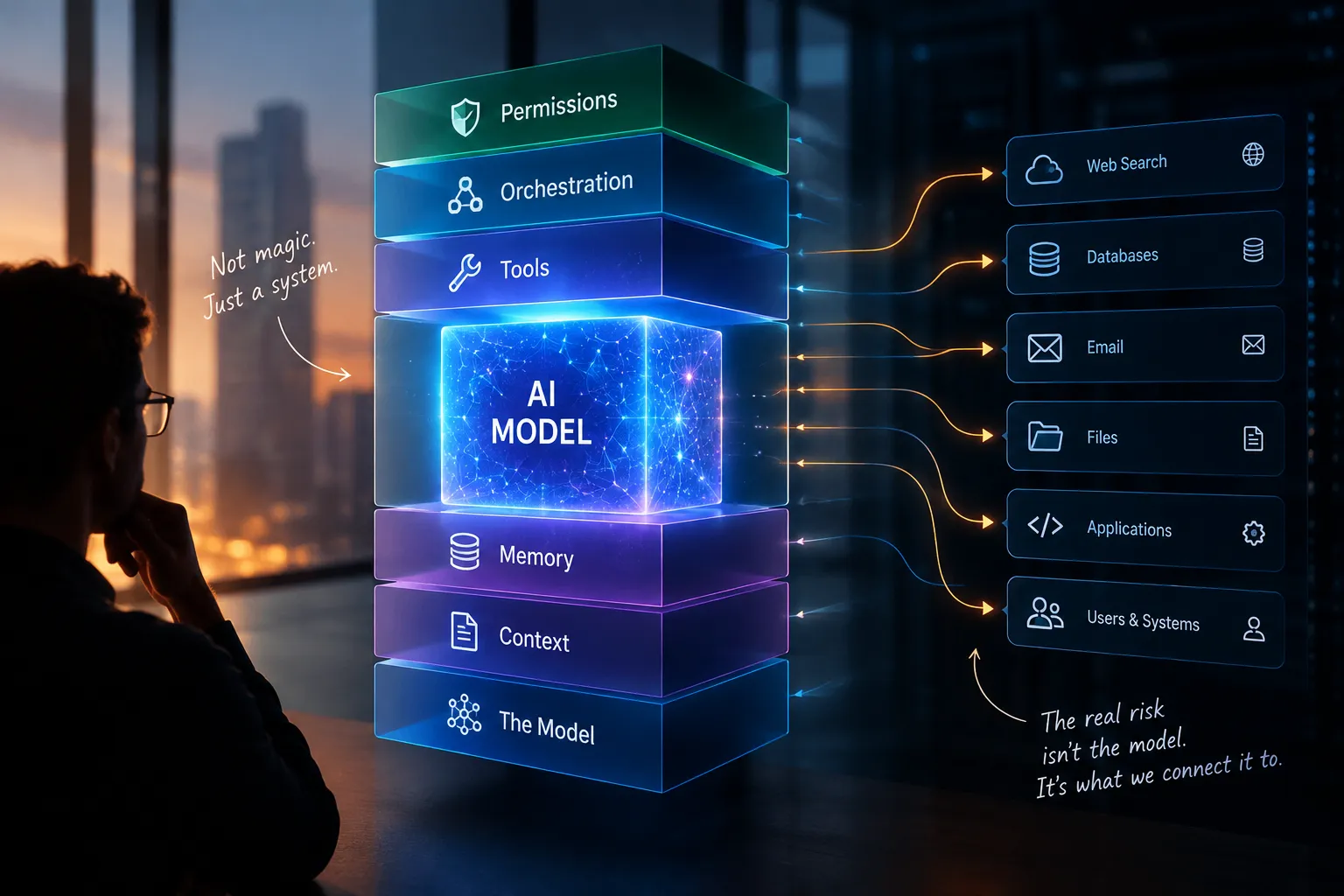
A useful way to think about an AI system is as several layers:
The model generates predictions and outputs.
The context layer determines what information is presented to the model.
The memory layer stores information that can be retrieved and presented again later.
The tool layer gives the system access to things such as web search, databases, APIs, files, or other software.
The orchestration layer decides when to call the model, when to call a tool, and whether to repeat the process.
The permission layer determines what the system is actually allowed to see or change.
This is where many discussions about AI go wrong. The capabilities of the complete system are routinely attributed to the model itself.
Myth #1: "AI doesn't just follow instructions. It learns from experience."
The reality
An LLM does not execute instructions in the same way a conventional software program executes instructions. It processes its input and generates a probability distribution over possible continuations. The surrounding software then turns that output into something useful.
That surrounding software can be extremely sophisticated. It can provide system instructions, retrieve documents, maintain conversation history, call external tools, validate results, and send the output into another process.
This can make the overall system look like a single intelligent entity.
But the distinction between model behavior and system behavior matters.
During a normal inference pass, the model's parameters are not rewritten by the conversation. The model does not permanently absorb a new fact simply because a user typed it. What people experience as "memory" is usually context carried into later requests, or information stored by an external memory system and retrieved when needed.
This is also why an AI can appear to learn without actually changing its internal parameters. A model can adapt its behavior to examples and information placed in its current context without those examples becoming part of its trained weights.
The result can look remarkably like learning.
The underlying mechanism is different.
Myth #2: "AI can discover things and take actions on its own."
The reality
A bare model cannot open a browser, read your corporate database, send an email, or modify a file simply because it generated text describing how to do so.
Those capabilities come from the system around the model.
Consider a chatbot with web access. The model itself does not suddenly become connected to the internet. The application can expose a web-search tool, allow the model to request that tool, execute the request, and feed the result back into the model.
The same principle applies to other tools.
Give the system access to a filesystem and it can work with files.
Give it access to a database and it can query records.
Give it an email API and it can send messages.
Give it shell access and it can execute commands.
At that point, calling the system "autonomous" becomes much more reasonable. But the autonomy comes from the architecture and permissions, not from some magical ability of the model to escape its computational environment.
This distinction is especially important for security.
The interesting question is not:
"Can the AI think for itself?"
The useful question is:
"What can the software around the model allow it to do?"
That is a much more concrete security question.
Myth #3: "AI can predict the future and make decisions through genuine understanding."
The reality
A model can generate predictions, recommendations, strategies, essays, images, and decisions. The existence of an output, however, does not mean that the model possesses reliable knowledge about the underlying problem.
Consider a lottery.
Give an LLM years of historical lottery results and ask it to predict tomorrow's numbers. It will produce an answer. It may even produce a detailed explanation for why those numbers are supposedly more likely.
That does not mean the numbers are actually predictable.
The model is extremely good at producing a plausible continuation of the information it has been given. It is not automatically good at determining whether the underlying process contains any exploitable predictive signal.
This distinction between confidence and correctness is critical.
A model can generate a highly confident answer even when the correct answer is fundamentally unknowable from the available information.
The same problem appears in much more serious domains.
A model can recommend a business strategy.
It can propose an engineering design.
It can summarize a legal document.
It can diagnose a technical problem.
It can generate an investment thesis.
The output can be useful. But usefulness does not prove understanding, and fluency does not prove correctness.
AI systems are powerful pattern-generating machines. Whether those patterns correspond to reality depends on the data, the context, the task, the surrounding tools, and the quality of the verification process.
The real AI engineering problem
Once the model itself is fixed, a huge amount of practical AI engineering happens outside the model.
We can improve the context.
We can improve retrieval.
We can improve memory.
We can choose better tools.
We can constrain permissions.
We can validate outputs.
We can build feedback loops.
We can create better orchestration.
We can fine-tune or retrain the model when appropriate.
And all of this can make the overall system dramatically more capable without changing the underlying model during normal operation.
This is why two products using the same underlying model can feel completely different.
The model is only one component.
In many real-world applications, the engineering around the model is where much of the value is created.
Prompting is only one small part of that engineering. Context construction, retrieval, tool use, memory, permissions, validation, and orchestration are often far more important than arguing over the perfect sentence to place in a prompt.
Where corporate AI fears go wrong
This is where the current corporate conversation becomes interesting.
Large organizations are often presented with two extreme narratives.
On one side, AI is portrayed as an almost autonomous digital employee that can reason independently, learn from experience, and potentially become uncontrollable.
On the other side, AI is presented as a safe productivity feature that can simply be embedded into the existing enterprise stack.
Both narratives miss the underlying engineering problem.
An enterprise AI system is powerful precisely because it connects a statistical model to real information and real capabilities.
The model may not have inherent authority.
The system can.
Give a model access to company documents, mailboxes, customer records, internal applications, source code, or production systems, and the security implications change dramatically.
The risk is therefore not primarily that the model "becomes conscious" or "decides to attack the company."
The risk is that we connect a probabilistic system to valuable resources and give it more permissions than we properly understand.
This is a familiar engineering problem.
We have seen it before with web applications, databases, cloud services, APIs, and identity systems.
AI does not abolish those security principles.
It makes them easier to overlook because the interface is conversational.
A traditional application might expose a database query through a carefully defined form.
An AI assistant can expose much of the same capability through natural language.
That feels fundamentally different.
From a security perspective, the underlying problem is much more familiar.
The real thing to fear
The most interesting AI systems are not dangerous because the model suddenly becomes an autonomous mind.
They become powerful because someone gives the model:
context + memory + tools + permissions + automation.
That combination creates a system capable of taking meaningful actions in the real world.
And that leads to a more useful question than "Is AI conscious?"
Ask instead:
What data can it access?
What tools can it call?
What actions can it take?
What permissions does it inherit?
Who validates its output?
What happens when it is wrong?
Those are engineering questions.
They can be tested.
They can be audited.
They can be constrained.
They can be monitored.
And unlike the idea of an autonomous machine mind, they are actually relevant to the security of a company.
The irony is that corporations may be spending too much time worrying about whether AI is "truly intelligent" and not enough time examining what their AI systems are actually connected to.
The model is not the whole AI.
The system around the model is where the real power lives.
And that is where the real security boundary should be.