Building bwengineering.hu with AI: a case study in who gets to build now
A four-tier AI workflow — design, architecture, orchestration, and code — took bwengineering.hu from spec to a Lighthouse-perfect, bilingual, lead-generating site in weeks, run by one engineer.
Building this site with a governance toolkit was the first case study: a personal portfolio, one operator, one agent. bwengineering.hu is the second, and a harder one — a real commercial site for a real business, Biroworks Mérnöki Iroda Kft. (BWE Mechanical Design), the CAD design, 3D printing, and contract manufacturing firm I run. Getting it wrong has a real cost: a broken contact form is a lost lead, not a portfolio blemish.
Four roles, four tiers
The build split into four distinct AI roles, kept deliberately separate rather than pointed at one model with instructions to "build a website."
Design produced six pixel-accurate, high-fidelity mockups — real colors, typography, spacing, copy, and interaction logic, not wireframes — before any framework decision was made.
Architecture came next: a structured interview that produced a 25-document specification covering business goals, information architecture, the design system, the content model, SEO/performance/accessibility/security strategy, deployment, coding standards, testing, and a running risk register. Every non-trivial decision — framework, hosting, CMS, email delivery, spam protection — was made and written down before implementation started, not discovered along the way.
Orchestration and review (Claude Code, Sonnet) turned that spec into small, scoped tasks, dispatched them, and reviewed what came back. Architecture calls, production/DNS decisions, anything security-adjacent — none of that was delegated further down; it stayed with the orchestrator.
Coding (Claude Code, Haiku) did the bulk implementation, one page or component or migration task at a time, each scoped against the committed spec and an existing pattern to match. Cheap and fast, because by the time work reached this tier there was nothing left to decide — only something to build.
The tiering is the point, not an artifact of cost-cutting. Expensive reasoning where reasoning is actually needed; cheap execution everywhere else. That allocation is what makes the whole approach viable for a business this size — not just possible, but affordable.
What actually shipped
Astro on Cloudflare Pages replaced WordPress and Elementor — free tier, no bandwidth cap, commercial use explicitly permitted, retiring prepaid hosting the old site didn't need. Bilingual Hungarian/English from day one. A contact form wired end-to-end with Turnstile, a honeypot, and rate limiting, built and verified first because it's the business-critical path, not left until the end. A content model so copy changes don't require a developer, plus a git-backed CMS for the blog, which is already publishing on its own cadence — injection-molding economics, STL-to-STEP reverse engineering, 3D scanning versus measurement. Full SEO, analytics, and Google Ads instrumentation, wired and checked against real GA4 data rather than assumed correct.
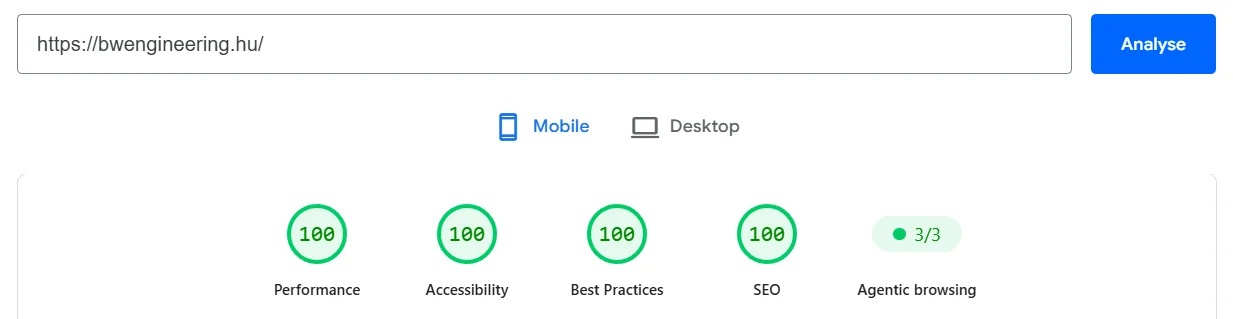
And the numbers: 100/100/100/100 on Performance, Accessibility, Best Practices, and SEO — mobile, PageSpeed Insights, 1 August 2026 — plus a clean pass on the newer "Agentic browsing" check, which scores whether the page holds up to being read by an AI agent, not just a human visitor. Phase 0 to DNS cutover: about three weeks.
Who was actually running it
One person — a mechanical and systems engineer who also runs the business the site sells for. No agency, no freelance developer, no in-house hire. The spec says as much directly: Claude, via Claude Code, is treated as "the ongoing technical operator, not a hired agency or in-house developer." That's a small business budgeting for an operator, the way it would budget for a part-time hire, not commissioning a project with a start and an end.
Why this isn't really a story about code
The bottleneck a small business hits was never really "who can type the code." It's translating domain knowledge — which service tiers actually matter, what a real lead looks like, which manufacturing detail is the differentiator, which search terms real customers type — into something shipped, correct, fast, and findable. That translation used to mean paying for a developer, a designer, and an SEO consultant, or doing a worse version of all three yourself and hoping it held together.
Tiered AI collapses that cost without collapsing the quality, because it separates judgment from execution and prices each one correctly instead of pricing everything at the top rate. It's the same principle from the other side, in my Hirschmann Car Communication post: a well-specified requirement is what lets mechanical, hardware, software, and manufacturing teams work without friction, because the ambiguity gets resolved once, upstream, instead of resolved badly and repeatedly downstream. Design, architecture, orchestration, code — that's the same discipline, applied to an AI system's own labor instead of a human org chart.
That's who this actually enables: not people who already know how to build software, but people who hold real cross-domain knowledge and never needed to learn. An engineer who understands their own manufacturing process, their own customers, and their own market better than any agency brief could capture — and who can now specify a site directly instead of translating that knowledge for someone else to build, losing something every time it changes hands.
Not a one-off
Different tiering than the governance model behind this portfolio, same underlying discipline: spec before code, human sign-off at the decisions that matter, machine execution everywhere else. bwengineering.hu is live now, in Hungarian and English, and its blog is still being written the same way this post was — a human directing, AI executing, nothing shipped that wasn't specified first.