Elfojtott könnyek szobra: engineering a human-scale outdoor sculpture in PETG
How BWEngineering built a permanent outdoor sculpture from 3D-printed PETG — hollow-body construction with a plaster core, weatherproofing for the Danube embankment, and the print logistics of a human-sized piece.
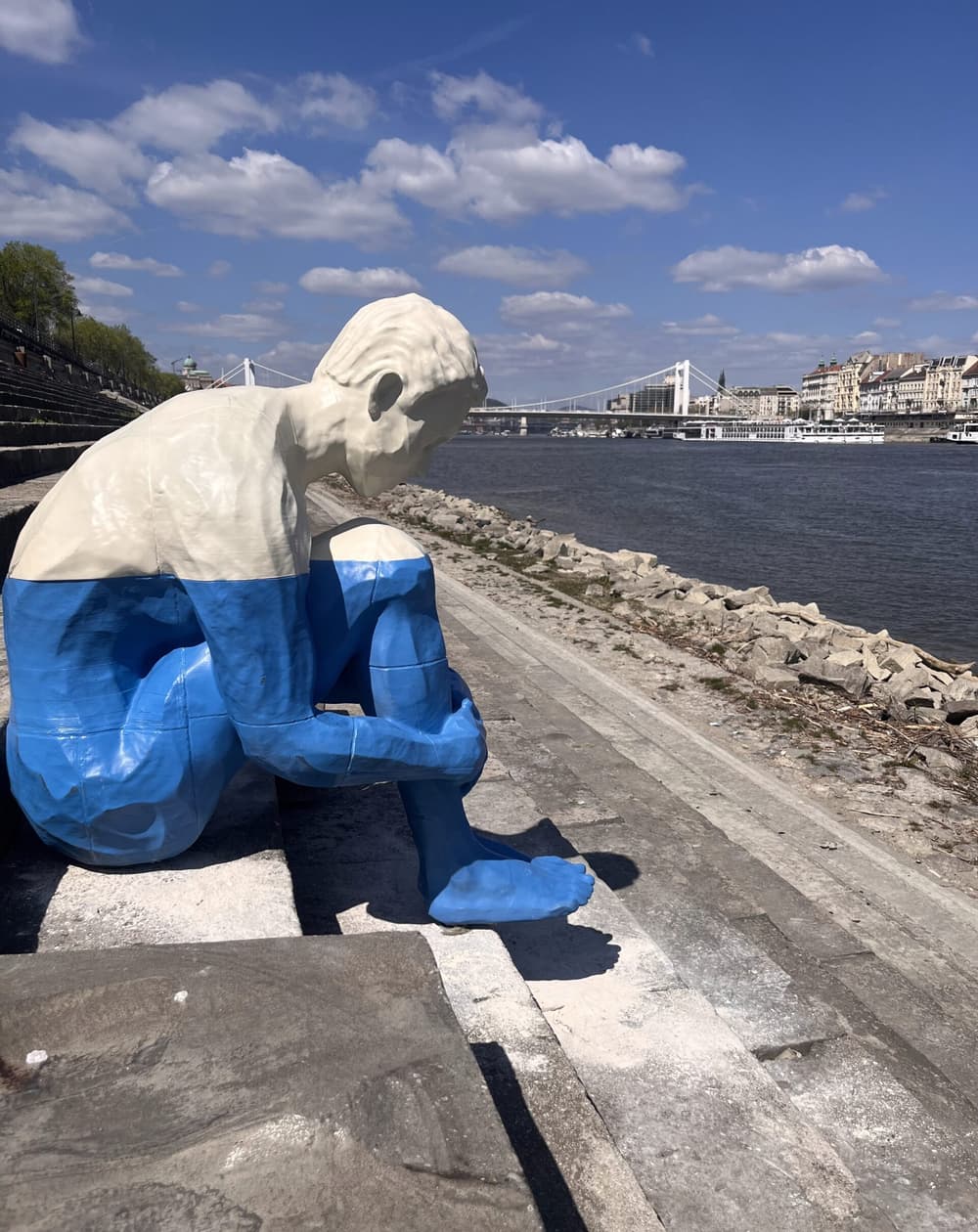
BWEngineering was commissioned by Mediator Group Kft. to build a permanent public sculpture for a LESZ Foundation awareness campaign — a Hungarian mental-health initiative built around a simple, blunt message: men feel pain too, even when they don't show it. The brief called for a human-scale seated figure, 3D-printed in PETG, installed outdoors and left there indefinitely. It now sits on the Danube embankment steps at the Buda bridgehead of Liberty Bridge, looking out over the river.
That last detail — permanent, outdoors, on a riverbank — is what actually shaped the engineering. A gallery piece behind glass doesn't need to survive freeze-thaw cycles, UV exposure, or a flood. This one does.
Scale and the print logistics
The finished figure measures 502 × 907 × 820 mm — roughly the footprint of a seated adult. No FDM printer bed is anywhere near that size, so the model had to be broken into dozens of separate components, each sized to fit the print volume, oriented to minimize support material, and keyed so the pieces would register back together without a visible seam offset. Printing all of it took about two weeks: PETG, 1.75 mm filament, roughly 30 kg and 3.2 km of it in total, at a 0.2 mm layer height through a 0.4 mm nozzle.
Decomposition is the unglamorous part of large-format printing. Splitting a human figure into knees, forearms, torso sections, and a head that all have to reassemble into something that reads as one continuous body means every parting line has to be planned before the first layer goes down, not fixed in post. Get the orientation wrong on a curved section and you either print with excessive support that damages the surface on removal, or you introduce a visible print-direction mismatch at the seam.
Material and the plaster core
PETG was the material call, not PLA or ABS. PLA is easy to print but embrittles and deforms under UV and heat over a Hungarian summer; ABS warps badly at this scale and needs an enclosure most shops don't have for prints this large. PETG holds dimensional stability outdoors and takes a primer coat well, which matters for the next stage.
The more consequential decision was the wall structure. Each printed segment is a 1.5 cm shell, not a solid block — full plastic infill at this volume would have meant either an impractical amount of filament or a structurally weak lightweight infill pattern that couldn't take real outdoor loads. Instead, the hollow interior is filled with gypsum after printing. That's a plaster core inside a printed plastic skin: it adds mass and a low center of gravity for stability against wind, it gives the structure the option to embed metal reinforcement where load paths need it, and it's simply cheaper than solving the same stiffness problem with more plastic. The printed shell becomes formwork as much as it's a finished surface.
Assembly and weatherproofing
Once the plaster cures, the segments get bonded together with a sealant designed for plastic-to-plastic joints, and every seam gets sanded down so the transition between printed sections disappears under hand. That's before any finishing work — sanding a joint that's still visually a joint just means you've prepared a good surface for paint, not solved the actual seam.
The finish is a two-component plastic primer followed by a matte lacquer formulated for UV and weather resistance, applied by a specialist finisher (Szín-Med Kft.) rather than in-house. This is the step that actually determines whether a PETG print survives multiple years outside rather than one summer: raw printed PETG left exposed will chalk and degrade under UV within a season. The lacquer is doing the weatherproofing; the print underneath is providing the geometry; the plaster core is providing the mass and stiffness. None of the three does the whole job alone.
Site realities
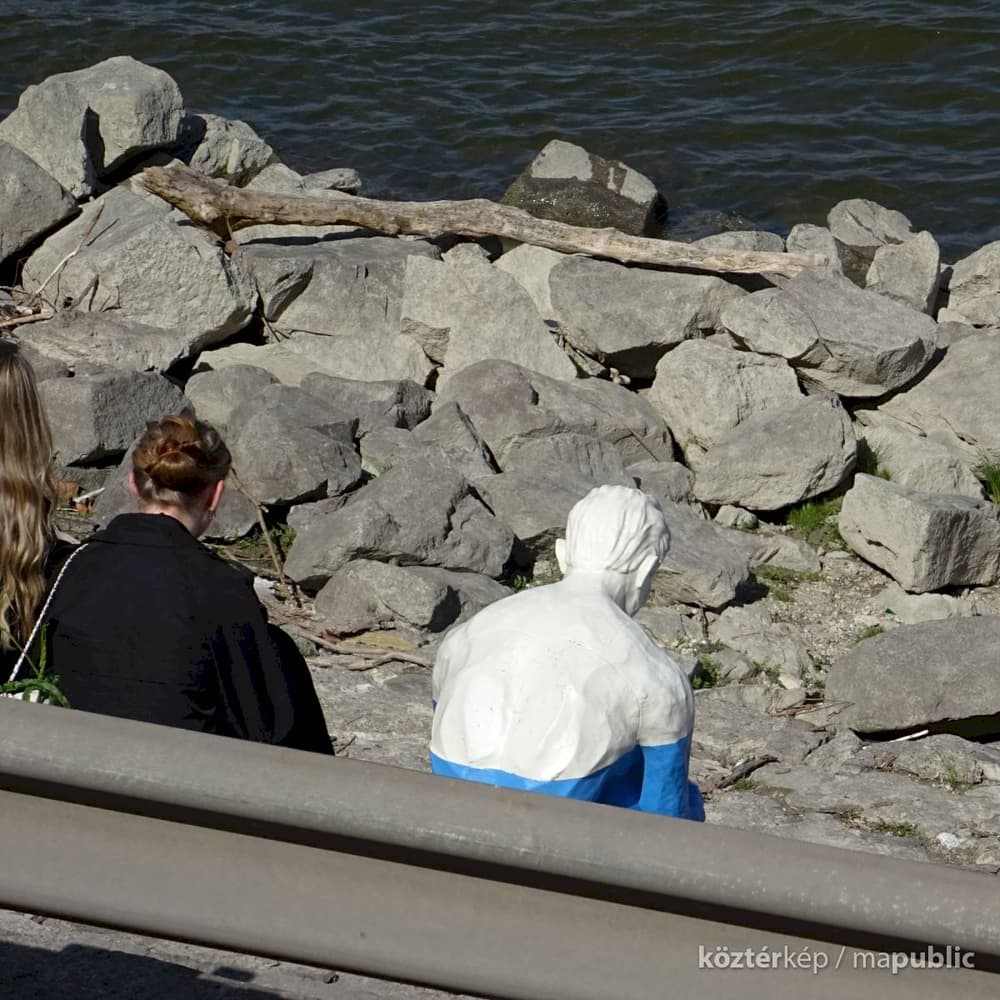
The installation site is a stepped embankment that floods periodically — it's built into the riverbank's flood-defense profile, not a raised plinth. That constrains the piece in ways that don't show up in a render: the mounting has to tolerate submersion without lifting or shifting, and the same plaster-core mass that provides wind stability also helps keep the piece anchored when the water rises over the steps. Engineering for a riverbank installation means designing for the flood as a recurring condition, not an edge case.
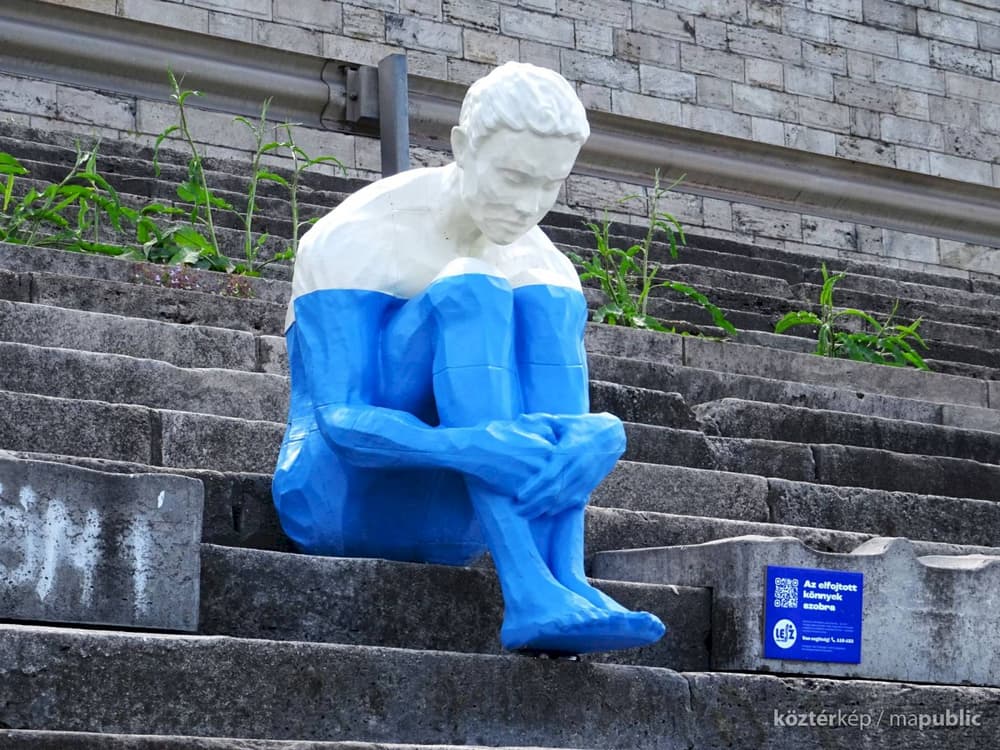
The result
The result is a sculpture that reads, from a distance, like a single cast object — a seated figure in cream and blue, looking out at the Danube. Up close, it's a stack of engineering decisions: a print strategy that solves for bed size, a hollow-plastic-and-plaster structure that solves for mass and stiffness, and a finishing process that solves for a Hungarian outdoor climate over years, not months. It's one of the projects that comes through BWEngineering, the engineering and additive-manufacturing studio I run alongside the day job. The piece is documented publicly on Köztérkép, Hungary's public art registry.